“We want to move, but we have to sell our house first.”
That may be one of the most common concerns I hear from homeowners throughout Melrose, Medford, Malden, Wakefield, Stoneham, Revere, and other North of Boston communities.
Many families know their current home no longer fits their needs.
Maybe they need more space.
Maybe they are looking to downsize.
Maybe they want a different location, a shorter commute, or a home that better fits their current stage of life.
The challenge is not deciding to move.
The challenge is figuring out how to sell your current home and buy your next home without ending up in a stressful situation where you own two homes at once or, even worse, have nowhere to go.
The good news is that people successfully buy and sell at the same time every day.
The key is having a plan before either transaction begins.
Why Selling and Buying at the Same Time Feels So Stressful
For most homeowners, their current home represents a significant portion of their net worth.
The equity in that property is often needed to purchase the next one.
That creates a natural question:
Do you sell first or buy first?
Unfortunately, there is no one-size-fits-all answer.
The right strategy depends on your finances, risk tolerance, housing needs, and local market conditions.
The mistake many homeowners make is assuming they have to figure it out on their own.
A successful move starts with understanding all of your options before making any commitments.
The Biggest Fear Homeowners Have
Most homeowners are not worried about selling their house.
They are worried about what happens after it sells.
Questions I hear all the time include:
- What if my house sells before I find another one?
- What if I find a house but my current home hasn’t sold yet?
- What if I have to move twice?
- What if I lose my dream home because my house isn’t under agreement?
- What if I am carrying two mortgages?
These are legitimate concerns.
Many homeowners also worry about whether giving up a historically low mortgage rate is worth making a move. If you are facing that question, read my article about deciding whether to give up a low mortgage rate to sell.
Fortunately, there are strategies that can help reduce or eliminate many of these risks.
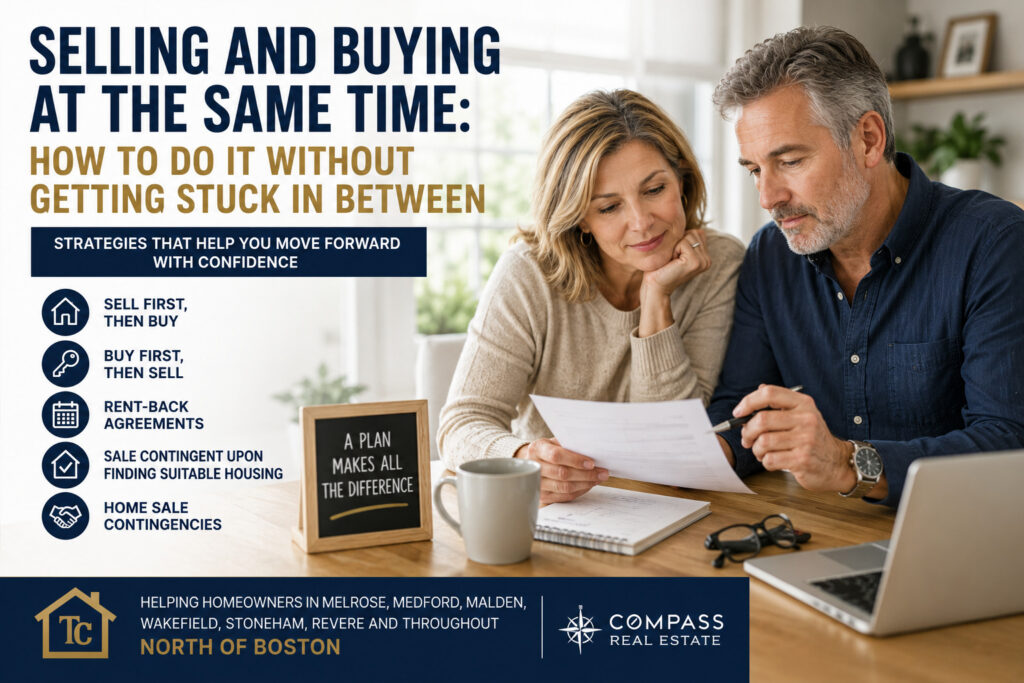
Option 1: Sell First, Then Buy
For many homeowners, selling first is the most conservative approach.
Why?
Because you know exactly how much money you have available for your next purchase.
You eliminate the risk of carrying two homes.
You know your budget.
You know your proceeds.
You know your timeline.
The downside is that you may need temporary housing if your home sells before you find your next property.
That possibility makes many homeowners nervous.
However, there are ways to manage this situation successfully.
Option 2: Buy First, Then Sell
This strategy works best for homeowners who have significant financial flexibility.
The benefit is obvious.
You find your next home before giving up your current one.
You move once.
You avoid temporary housing.
You reduce the pressure of finding a home quickly.
The challenge is that carrying two homes can create financial risk if your current property takes longer to sell than expected.
This strategy requires careful planning and realistic expectations.
Option 3: Negotiate a Rent-Back Agreement
One of the most effective tools available to homeowners is a rent-back agreement.
A rent-back allows you to sell your current home while remaining in the property for a period of time after closing.
This gives you additional time to find and purchase your next home.
In competitive markets, buyers are often willing to accommodate this arrangement when properly structured.
For many homeowners, a rent-back creates the flexibility needed to coordinate both transactions successfully.
Option 4: Make the Sale Contingent Upon Finding Suitable Housing
Another strategy that many homeowners use is making the sale of their home contingent upon finding suitable housing.
In this scenario, the seller accepts an offer on their home, but the agreement states that the sale is contingent upon the seller finding and securing their next property.
This approach can provide significant peace of mind because it reduces the risk of becoming homeless or being forced into temporary housing before finding the right home.
The benefit is obvious.
You can move forward with selling your home while maintaining some protection if your next purchase takes longer than expected.
The downside is that not every buyer will be willing to accept this contingency. In a competitive market, some buyers may prefer homes without additional seller contingencies.
However, when properly explained and structured, many buyers understand the situation and are willing to work with sellers who need time to secure their next home.
For homeowners who are nervous about selling before they buy, this can be an excellent middle-ground strategy.
Option 5: Use a Home Sale Contingency
A home sale contingency allows you to purchase a property contingent upon the successful sale of your current home.
This can reduce risk because you are not obligated to complete the purchase unless your home sells.
The challenge is that some sellers prefer offers without contingencies, especially in competitive markets.
Whether this strategy is viable depends heavily on market conditions and the specific property.
What I See Most Often in Today's Market
Throughout Melrose, Medford, Malden, Wakefield, Stoneham, and Revere, I am seeing many homeowners successfully make this transition.
If you are considering a move in Melrose, speaking with a Melrose MA real estate agent can help you understand your options before making a move.
The key difference between those who experience a smooth move and those who experience unnecessary stress is preparation.
The homeowners who do best typically:
- Understand their home’s value before shopping
- Meet with a lender early
- Develop multiple backup plans
- Understand local inventory conditions
- Create a realistic timeline
The process becomes much easier when expectations are aligned with market realities.
The Importance of Knowing Your Home's Value First
Before looking at homes online, scheduling showings, or attending open houses, it is important to understand what your current home may realistically sell for.
This information impacts everything:
- Your budget
- Your down payment
- Your monthly payment
- Your financing options
- Your overall moving strategy
Too many homeowners begin searching for a new home before understanding the financial side of the equation.
Knowing your options first creates confidence and reduces uncertainty.
Questions Homeowners Should Ask Before Moving
Before deciding whether to sell first or buy first, ask yourself:
- How much equity do I currently have?
- How quickly do I need to move?
- Am I comfortable with temporary housing if necessary?
- Can I financially support two homes for a period of time?
- How competitive is the market where I want to buy?
- What would a successful transition look like for my family?
The answers help determine which strategy makes the most sense.
The Bottom Line
Selling and buying at the same time can feel overwhelming.
The good news is that it does not have to be.
Every homeowner’s situation is different.
The best strategy is not the one your neighbor used.
It is not the one you read about online.
It is the strategy that aligns with your finances, goals, timeline, and comfort level.
The homeowners who experience the smoothest transitions are usually the ones who start planning before they need to move.
If you are considering selling your home in Melrose, Medford, Malden, Wakefield, Stoneham, Revere, or anywhere throughout North of Boston, I would be happy to walk you through your options and help you create a plan that works for your specific situation.
Moving is stressful enough.
You should not have to figure it out alone.